Four Volunteers Walked Out of 378 Days on Pretend Mars
After more than a year of slow messages home and limited supplies, four volunteers left a 3D-printed habitat in Houston on October 31. Two weeks of debriefs come next, and NASA says what they recorded could shape how it feeds and supports crews on the Moon and Mars.
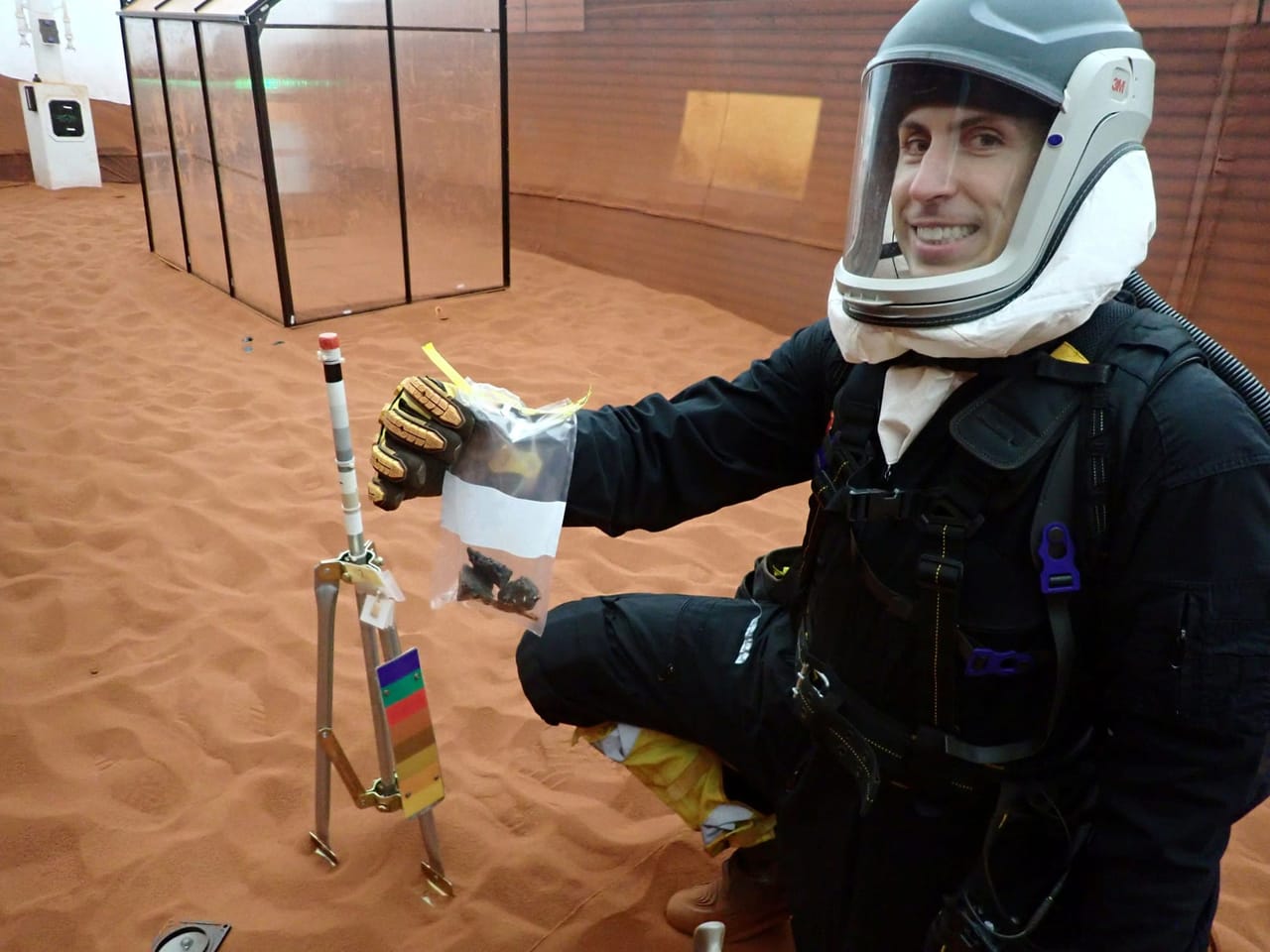
Four people walked out of a building in Houston on Saturday, October 31, while friends and family cheered them on. They had gone in on October 19, 2025, and stayed 378 days. None of the four has been to Mars. For more than a year, they lived as if they were there.
The volunteers are Ross Elder, Ellen Ellis, Matthew Montgomery and James Spicer, the crew of the second mission of NASA's CHAPEA project, short for Crew Health and Performance Exploration Analog. Their home for the mission was a 3D-printed habitat of about 1,700 square feet, inside a hangar at NASA's Johnson Space Center.
A crew with day jobs
NASA describes Elder, the commander, as a US Air Force major and experimental test pilot. Ellis, the medical officer, is a US Space Force colonel with four master's degrees, one of them in emergency and disaster management. Spicer, the flight engineer, works on satellite communications for the aerospace industry. Montgomery, the science officer, is an electrical engineer who consults for technology start-ups and co-owns a Los Angeles film production company.
Their moods before the start were refreshingly human. "I'm probably far less nervous than I should be for a year away on Mars," Elder said. Spicer admitted to being a little "trepidatious" about spending "12, 13 months together in a box." Elder's own hope was simple: that the four of them would "still walk out hand in hand the same."
Ellis set a more measured goal: "to produce as much data as possible." She also spoke of a "strong sense of purpose" and said that leaving her family made her look inward. Spicer hoped the crew would be "having a reunion dinner" in ten years. For this team, success was never only the data. It was also still liking one another at the end.
Rules of a made-up planet
The point of the habitat was to make life hard in the ways a real Mars trip would be. Supplies were limited. The crew was shut in together. Equipment could fail. The mission also included simulated spacewalks, on which crew members collected rock samples, as well as growing crops and maintaining the habitat.
Messages to the outside world were slowed on purpose. Before the mission, Spicer pointed out that a delay of 13 to 22 minutes means a crew cannot wait for Earth to answer every question and has to decide for itself. It was a familiar problem for him, since his day job involves satellite communications and space data relay networks. Email was the crew's only way to reach family and friends, and Spicer said he received more than 4,000 of them. For two full weeks, there was no contact at all, a test of what a real blackout would be like with the sun between Earth and Mars.
What the year is for
The real work is the data. NASA says the stressors built into the mission, namely communication delays, limited resources and isolation, are the ones future Moon and Mars travelers would meet. What the volunteers recorded can help the agency improve how food systems are designed, how crew time is used, and how a crew uses bandwidth on NASA's Deep Space Network. That network is NASA's global system of giant radio antennas that supports missions to distant spacecraft.
The same data can help flight doctors and psychologists strengthen medical care and behavioral support for spaceflight. NASA says it can feed into its Artemis Moon program and what it calls Moon Base missions, and help it "develop methods to counter human spaceflight risks."
There is a lot to compare against. The first CHAPEA crew lived in the same habitat from June 25, 2023, to July 6, 2024, also for 378 days. They grew and harvested vegetables too, and their commander, Kelly Haston, began with a simple hello when they emerged: "It's actually just so wonderful to be able to say 'hello' to you all." Science officer Anca Selariu, who had been asked many times why there is a fixation on Mars, answered: "Why go to Mars? Because it's possible."
Still ahead
The crew's work is not finished. Two weeks of evaluations with NASA scientists come next. "This will be the first time we get to sit down and talk with them," said Suzanne Bell, one of the project's co-investigators, because until now everything arrived on the communication delay.
The next project is already lined up. NASA is taking applications for a new year-long project called the Moon and Mars Exploration Analog, which mixes CHAPEA with the agency's other space simulations. It will start no earlier than August 2027.
A real trip to Mars is still far away. In his first remarks outside, Elder called the goal of putting humans there "not only achievable, but rather inevitable." For now, the closest thing to the journey is a year in a building in Texas, where the biggest test for four ordinary people was one another.
This article was written by artificial intelligence and may contain mistakes.