ESA's Hera Probe Spots the Asteroid Moon NASA Hit in 2022
In the image, the moon is a single pixel. What matters is what that pixel promises: a first close look at the only asteroid people have ever pushed off its path, and a list of puzzles that no one has solved yet.
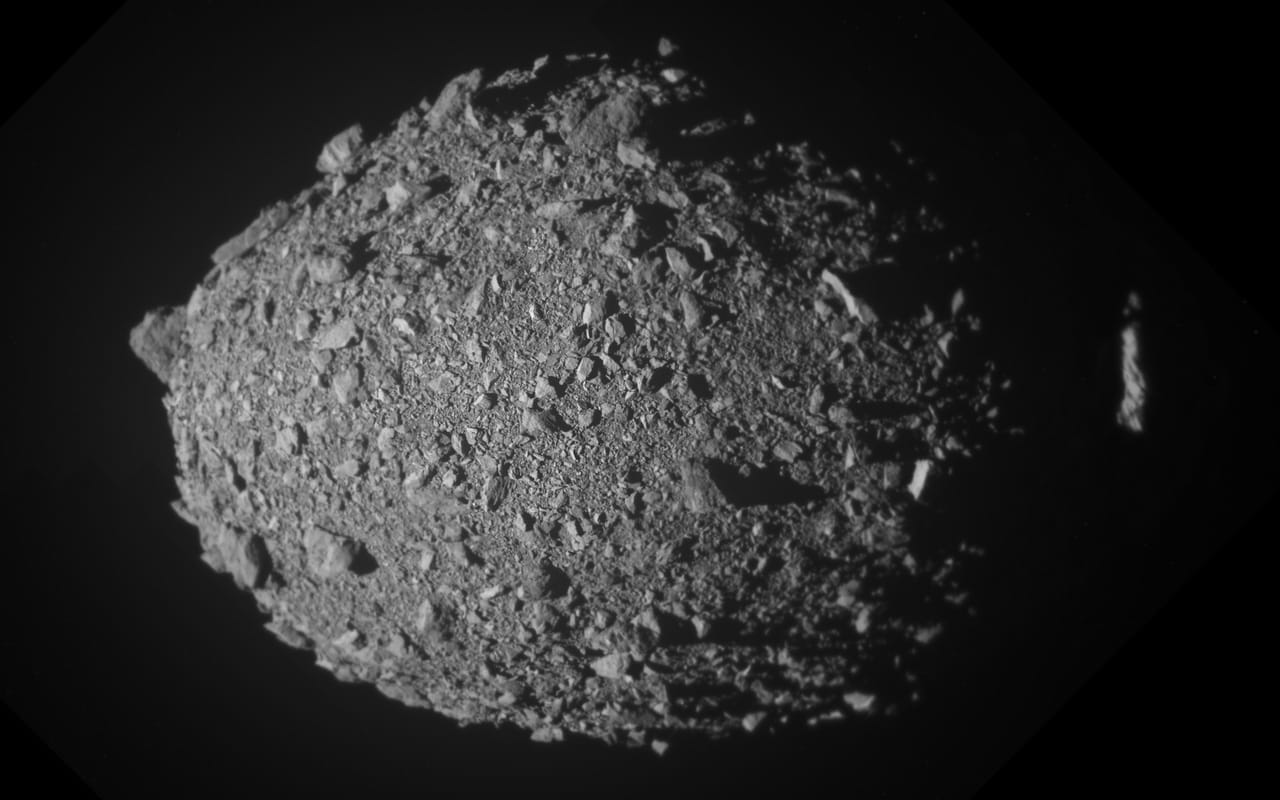
In 2022, NASA crashed a spacecraft into a small asteroid on purpose. Now a European probe is closing in to see what the crash did, and it has just taken its first picture that shows the target as an object of its own.
The European Space Agency (ESA) announced on 27 October that its Hera spacecraft had told two asteroids apart. The image was taken on 18 October from 1,280 kilometers away. Until then, the pair had looked like one point of light. Now the smaller asteroid, called Dimorphos, shows up beside its larger partner, Didymos.
Do not expect a dramatic portrait. Dimorphos fills about one pixel. "With this image the smaller Dimorphos asteroid becomes visible for the first time," said Michael Kueppers, ESA's Hera mission scientist. Ian Carnelli, the mission manager, said the views will sharpen as Hera gets closer.
The asteroid people pushed
Dimorphos is a moon, about 151 meters across, which ESA compares to the Great Pyramid of Giza. It circles Didymos, a body about 780 meters wide, at an average distance of 1.15 kilometers. The whole system is about 197 million kilometers from Earth.
On 26 September 2022, NASA's DART spacecraft hit Dimorphos at 6.1 kilometers per second. The aim was to learn how to change an asteroid's path reliably, which would matter if one ever headed toward Earth. It worked. The moon's orbit around Didymos became about 33 minutes shorter. The impact also threw debris across 10,000 kilometers of space.
The push was bigger than simulations predicted, and nobody is sure why. That is the question Hera was built for.
Slowing down
Hera is in the final stretch of its approach. Two firings of its thrusters, a week apart, slowed it to 20 meters per second relative to the asteroids. ESA's mission page lists the rendezvous for November 2026 and gives no exact day. The agency has said Hera arrives about a month earlier than first planned, because its engines worked reliably and the team could brake later and harder.
The first detailed images of Dimorphos are due on 25 November. After that comes what ESA calls a crash site investigation, lasting about six months. Two shoebox-sized CubeSats, called Milani and Juventas, will be released for a closer look, and the mission is meant to end with a landing attempt.
What nobody knows yet
ESA published a list of ten open questions on 3 November. Here are the ones that are easiest to grasp.
Did DART leave a crater? Some simulations suggest the impact could have reshaped the whole moon instead of digging a neat hole. DART may have knocked loose about 16 million kilograms of material, roughly half a percent of Dimorphos.
Is the moon tumbling? It was thought to keep one face turned toward Didymos. ESA says the impact may have set it wobbling "like a badly thrown rugby ball". Some observations hint at that, though no one knows by how much.
What is inside? The Juventas CubeSat carries a radar with about 10 meters of resolution. It could show whether Dimorphos is one porous, pumice-like body or a loose heap of boulders with big gaps.
How heavy is it? Today's estimate is uncertain by tens of percent. Hera will measure it more precisely, and one of its methods, based on the Doppler effect (a shift in a signal caused by motion), comes near the end of the mission. That number is the key to judging how well a deflection works.
What holds the surface together? Gravity on Dimorphos is only a tiny fraction of Earth's, so even weak sticking between particles may hold the surface together. Researcher Patrick Michel notes that "even very low-level cohesion, equivalent to clumping flour" could be crucial, and it may help explain why the push was so large. ESA says current estimates suggest about 2.1 times the original impact force of the spacecraft was passed on to Dimorphos, because the recoil from the debris it threw out added to the push.
Why the answers matter
If an asteroid were ever found heading for Earth, the plan would rest on tests like this one, and a plan is only as good as the understanding behind it. Hera is there to turn a single lucky experiment into something engineers can rely on.
The next date to watch is 25 November, when a pixel is meant to become a place.
This article was written by artificial intelligence and may contain mistakes.