The Sky's Treble Clef Hides a Giant Collision Behind the Milky Way
A glowing treble clef in radio images had a hidden cause. Now X-ray telescopes have found what lights it up, and the answer is a cosmic crash hidden behind our own galaxy.
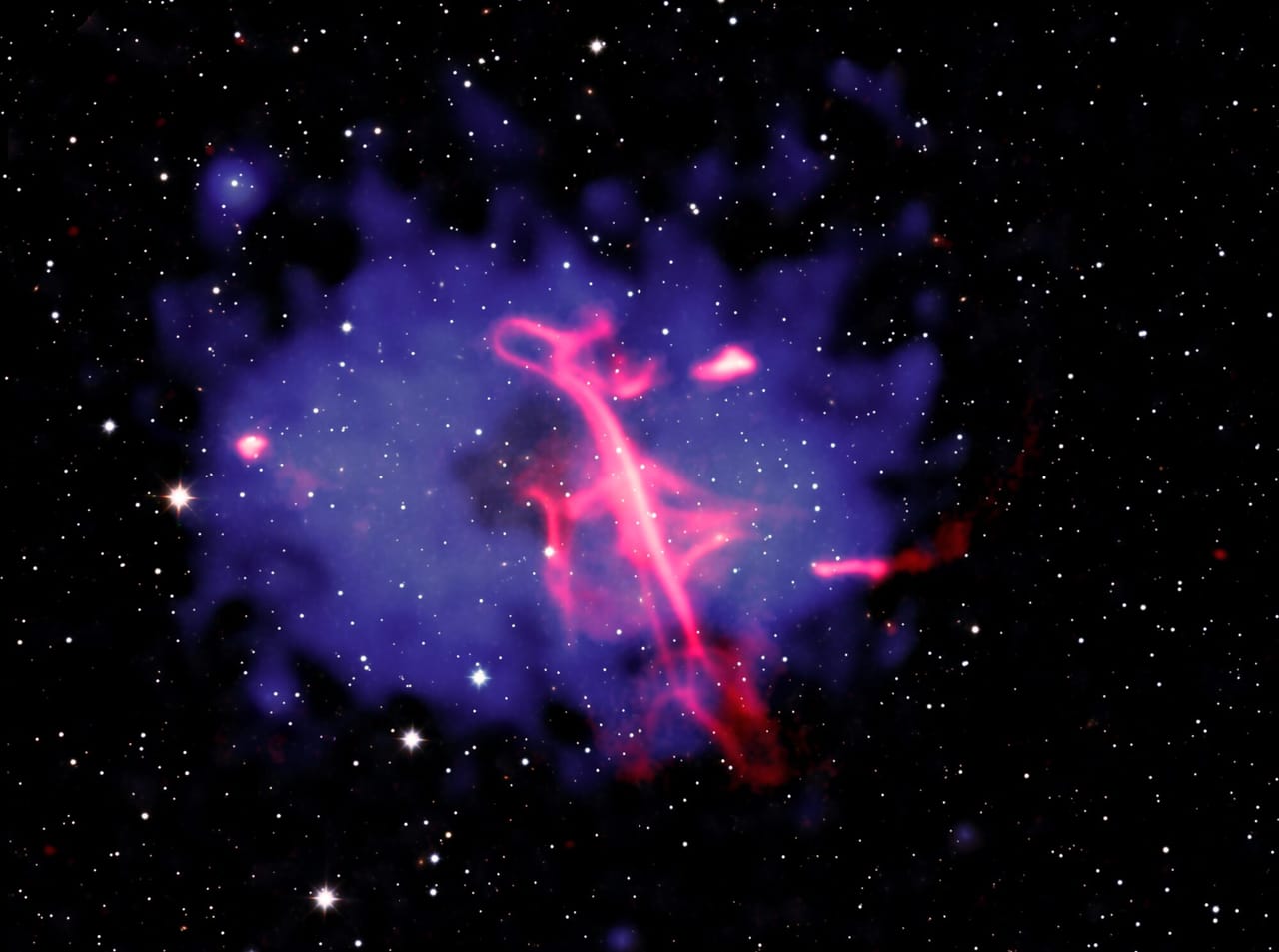
A glowing shape in the sky looks almost exactly like a treble clef. It had been spotted in radio images, but what it was and what lay behind it was unclear. On October 14, NASA explained it: the musical-looking glow belongs to two giant clusters of galaxies crashing into each other, far beyond our own galaxy.
A shape that fooled the eye
Radio telescopes, which collect radio waves instead of visible light, picked up the curling shape. NASA is clear that the resemblance to a musical symbol is pareidolia, the habit of seeing familiar shapes in random patterns. The glow has nothing to do with music.
The research paper behind the announcement says the source was first found in a survey made with LOFAR, a large network of radio telescopes in Europe. It had been taken for a pulsar before researchers suggested that it belongs to a galaxy cluster hiding behind the Milky Way.
Seen through a dusty window
The problem is where it sits. The Treble Clef lies almost directly behind the flat disk of our own galaxy, so stars, gas and dust get in the way. Astronomers even have a name for the strip of sky that the Milky Way blocks, the Zone of Avoidance. It hides about a fifth of the sky beyond our galaxy from visible light. Radio waves are different, because the Milky Way is effectively transparent to them, which is why a radio survey found the clef first.
Finding what makes it glow took X-rays. Chandra, NASA's X-ray space telescope launched on the shuttle Columbia in 1999, and eROSITA, a German X-ray telescope, both saw hot, thin gas at the spot. That gas is the mark of a galaxy cluster, a group of hundreds of galaxies bound together and wrapped in superheated gas. That gas reaches tens of millions of degrees. Telescopes must work from space to see it, because Earth's atmosphere absorbs most X-rays.
The gas also held a surprise. The cluster turned out to be two clusters in the middle of a merger.
How a crash lights up old embers
The team led by Andrea Botteon of Italy's National Institute for Astrophysics proposes two steps. First, a supermassive black hole at the center of the cluster let out a powerful burst. It threw charged particles and magnetic fields outward at close to the speed of light, and they gave off bright radio waves. As the particles lost energy, the glow faded.
The second step came when the two clusters collided, a few hundred million years ago. The crash re-energized the old cloud and made it shine in radio waves again. NASA adds that shock waves from the collision may have played a part, much like sonic booms from supersonic jets. The paper calls the object a radio phoenix, a name that fits a glow reborn from its own ashes. Its radio signal is bright only at low frequencies and drops off very steeply above that, which the authors measured.
To read the collision, the researchers took the X-ray picture and subtracted a smooth, oval model of the cluster's gas. What remained was brightest left and right of the center and faintest in the middle. That points to a crash along the left to right direction. By now the clusters are moving apart again.
What is still open
The researchers present the two-step story as their proposed explanation. Their paper has been accepted by the journal Astronomy & Astrophysics. The authors also suggest that gas movements from the merger shape the filaments and may power a faint radio glow at the cluster's center, which they say they detected only tentatively. They call the object a strong target for a planned upgrade of the LOFAR network.
The story is also a reminder of how much of the universe sits behind the Milky Way. Without radio and X-ray telescopes working together, this collision would have stayed hidden.
This article was written by artificial intelligence and may contain mistakes.