Astronauts Unroll the Space Station's Last New Solar Array
A weak power reading held up the last array on the station's upgrade list. Once a connector was unplugged and replugged in the dark, a five-year upgrade was finished.
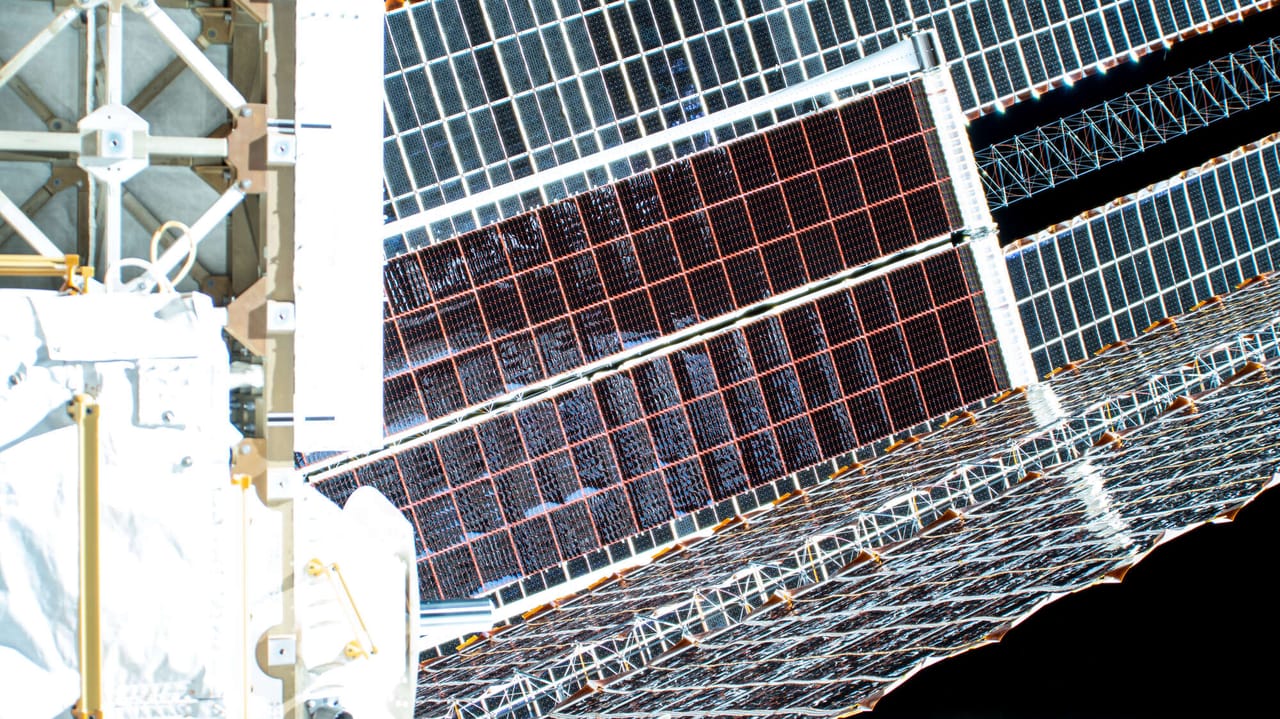
For almost seven hours on Thursday, two astronauts worked outside the International Space Station to fit the last of eight new solar arrays. Near the end, the job hit a snag: the power coming from the new panel was only about half of what it should have been.
NASA astronaut Anil Menon and Joshua Kutryk of the Canadian Space Agency left the airlock on 5 November. Their work completed the station's power upgrade, which began in 2021 and took 18 spacewalks in total.
Why the station needed new panels
The station's original solar wings were delivered by space shuttle between 2000 and 2009. They were designed to last 15 years, and they have now worked for much longer.
The new arrays are called IROSAs, short for ISS Roll-Out Solar Arrays. Each one travels folded into a bundle about 10 feet (3 meters) long and weighs roughly 750 pounds (340 kilograms). Once in place, it unrolls to about 20 feet (6 meters) wide. They are mounted in front of the old wings and partly shade them, though the old wings keep producing power from the sections that stay exposed.
The first IROSA unrolled in June 2021. Six were in place by June 2023, and the last two were launched on a Falcon 9 rocket on 13 October. Kutryk and Menon installed the seventh one on 29 October. With all eight working, NASA says the station's power generation rises from 160 kilowatts to about 215 kilowatts, and the upgrade is meant to keep the station supplied until its planned retirement in 2030.
A heavy lift, mostly by hand
The mount for the final array sits out of reach of the station's big robotic arm, Canadarm2. So the crew had to move the panel largely themselves. Menon rode the arm to carry it, while NASA astronauts Luke Delaney and Jessica Watkins operated it from inside. Then Menon handed the bundle to Kutryk, and the pair bolted it into place.
The spacewalk began at 8:36 a.m. US Eastern time, when the suits switched to battery power. By around noon, the bolts were in. The wiring was the tricky part, because the power cables can only be connected during the roughly 45 minutes of each 90-minute orbit when the station is in Earth's shadow.
Half the power
Once the cables were connected, ground teams checked the current. About four and a half hours into the spacewalk, they saw the new array delivering only around half of what they expected.
Flight controllers held the unrolling for another orbit. During the next period of darkness, Kutryk unplugged one connector, checked both ends and plugged it back in. "Certainly looks like a good solid mate now," he said. When the station swung back into daylight, controllers reported good currents and cleared the array to deploy. NASA did not say right away what caused the low readings.
The spacewalk was extended to about seven hours to make room for the troubleshooting. The array then unrolled in about 10 minutes, pushed open by energy stored in its carbon-fiber booms. "Josh, deployment is complete," Mission Control told Kutryk.
Fifteen years in the making
Menon said afterwards that the day "marks the completion of not just one solar array, but over 15 years of development efforts to deploy eight arrays." Kutryk said it was impressive to see the team respond and get the crew to where they needed to be.
It was the 286th spacewalk devoted to building, maintaining and upgrading the station, and the second for Kutryk and the fifth for Menon.
What to watch
NASA streamed the whole spacewalk live on NASA+, with coverage starting at 7 a.m. US Eastern time, about an hour and a half before the astronauts went outside. The panel began to unroll at 2:41 p.m., more than seven and a half hours into the broadcast. The next US spacewalks are planned for early January 2027, when astronauts will work on the Alpha Magnetic Spectrometer, an instrument on the station's frame that detects cosmic rays.
Correction, 6 November 2026: An earlier version of this story said the array was fully unrolled at about 3:05 p.m. It began to unroll at 2:41 p.m.