Humanoid Maker Agility Lists on Nasdaq With $1.8M in Revenue
Its robot already moves boxes in warehouses. Sales are tiny next to the money the listing raised, and the shares swung widely on the first day.
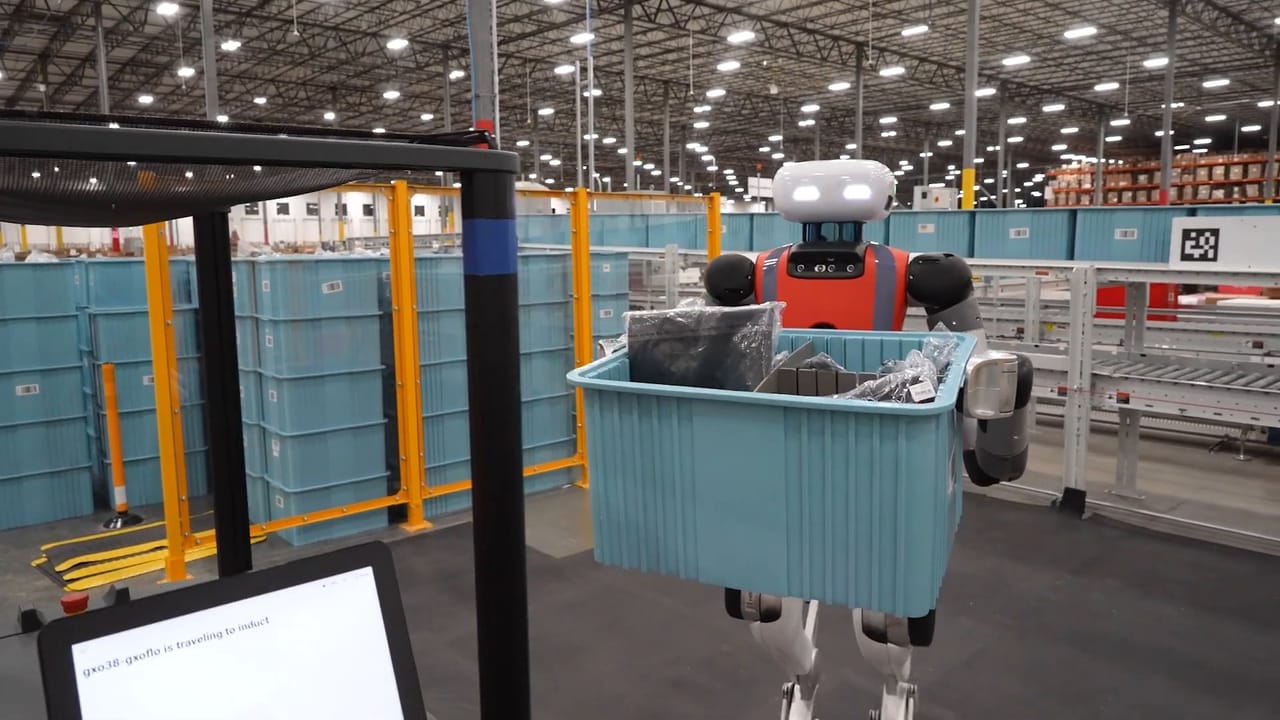
A company with about $1.8 million in revenue last year now has shares on the Nasdaq stock exchange. Agility Robotics, an Oregon maker of walking, two-armed robots, began trading on 5 November under the stock code AGLT. It calls itself the first publicly listed American company focused purely on humanoid robots, meaning robots built in the shape of a person, that already has robots at work for customers.
What Agility actually sells
Its robot is called Digit. It stands on two legs, has two arms, and does one plain job: it picks up storage containers, called totes, and moves them from one place to another in warehouses. Agility says Digit has logged more than 65,000 hours of real work.
The best-known example is a facility run by the logistics firm GXO in Flowery Branch, Georgia. There Digit lifts totes and places them on conveyor belts, alongside machines already in the building. It has moved more than 100,000 of them. GXO plans to bring Digit to two more American sites in early 2027. Other named customers include Schaeffler and Toyota Motor Manufacturing Canada.
Digit is not a robot butler. It does a narrow task, and that task is the whole business so far.
How it got listed
Agility did not hold a traditional share offering. It merged with Churchill Capital Corp XI, a blank-check company. In plain terms, that is a listed shell that raises cash first and then merges with a private business; the U.S. Securities and Exchange Commission describes it as having no business plan of its own beyond a merger or acquisition. Churchill was a special purpose acquisition company, or SPAC, a type of blank-check company set up to pool money for a merger or acquisition. The merger closed on 4 November, and the combined company started trading the next day.
The deal brought in about $465 million before costs. About $164 million came from the shell's own funds, about $201 million from a private share sale led by Foxconn, and about $100 million from investors who put money in after the deal was announced. That is well short of the more than $620 million that was projected in June, when the deal was unveiled at a value of $2.5 billion. A report on the deal suggested that many of the shell's shareholders took their money back instead, though Agility has not described it that way.
The numbers behind the debut
The financial details are modest. In 2025 Agility had revenue of $1.78 million, up from $310,000 in 2024, and it lost $138.1 million. About 64% of that revenue came from related parties, which the report does not break down further. It ended 2025 with $103 million in cash, before the new money arrived.
The company's hopes rest on its next robot, Digit 5, which it unveiled in September. Agility says it has more than $300 million in committed orders for it, spread over several years. Those orders depend on milestones and on the robot's final features, and the company is the only source for the figure. Early customers should get Digit 5 in the first half of 2027, with general sales planned for the end of the year.
An uneven first day
Agility opened at just over $11, above the $10 per share price used in the deal, and the day was a rough ride. The shares fell as low as $8.40, about 16% below the deal price, and rose as high as $12.15. They closed at about $11.50, a little above the open. The wider market was shaky too: the Nasdaq Composite index fell more than 5% that day, its worst day since April 2025.
Shares held by existing owners and by Churchill's sponsor are locked up for 180 days after the deal closed, with early release possible depending on the stock price, so they cannot simply be sold straight away.
Agility's chief executive, Peggy Johnson, said the company wants to become "the backbone of the humanoid industry." Agility says it is exploring other robot shapes and could license its technology to other humanoid makers. Jonathan Hurst, a co-founder, said Digit is unlikely to get wheels.
A small business, a big bet
Many humanoid robots are shown off in carefully staged demonstrations. Agility is one of the few companies whose robots do paid work in warehouses, so its numbers are a rare glimpse of how large that business really is. For now, the answer is small: a handful of customers, under two million dollars in sales and a large bet on a robot that has not yet reached them.